

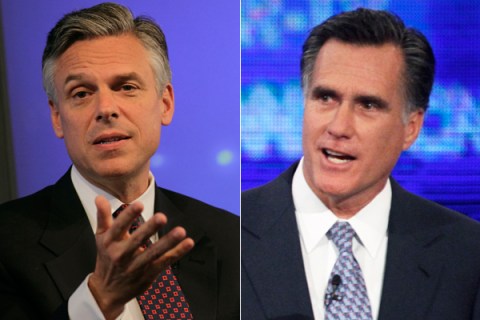
One of the few truly reliable campaign strategies for Republican presidential candidates over the last 40 years has been to run to the right of Democrats on foreign and national security policy no matter what the issue, no matter what the context. So why are two GOP contenders for the presidency risking an early soft line on the war in Afghanistan?
First, on Sunday, Jon Huntsman, who is expected to announce his run for the presidency within days said, “When you look at Afghanistan, can we hang out until 2014 and beyond? I would argue that we can if we’re willing to pay another quarter of a trillion dollars to do so but if it isn’t in our direct national security interest and if there isn’t a logical exit strategy and if we don’t know what the cost is going to be in terms of money and human lives, then I think you have to say it’s probably time we re-evaluate this.”
There’s a lot of if’s there, but there’s no mistaking that Huntsman is endorsing a turn away from Obama’s surge. More important, there’s no mistaking the doubt-filled tone, a campaign-trail mistake that Democrats have learned the hard way is political poison not just with Republicans but many independents.
Just a day after Huntsman’s comments, the putative GOP frontrunner, Mitt Romney, made similarly dovish comments about Afghanistan. When asked by a voter during the New Hampshire primary debate if it wasn’t time “for us to bring our combat troops home from Afghanistan,” Romney said, “It’s time for us to bring our troops home as soon as we possibly can, consistent with the word that comes to our generals that we can hand the country over to the Taliban military in a way that they’re able to defend themselves.”
Romney quickly corrected the embarrassing mistake—“Excuse me, the Afghan military to defend themselves from the Taliban,” he said—but the substance of the answer was equally damaging. And he made it worse by suggesting that the U.S. is in Afghanistan to fight for the country’s independence, rather than to fight America’s enemies. “Only the Afghanis can win Afghanistan’s independence from the Taliban,” Romney said.
Ron Paul immediately hit Romney for deferring to commanders in the field, but the tougher criticism has come from foreign policy heavyweights in the party. On Capitol Hill, Sen. Lindsey Graham attacked Romney hard. “From the party’s point of view, the biggest disaster would be to let Barack Obama become Ronald Reagan and our people become Jimmy Carter,” Graham told The Hill newspaper. Fearing that the GOP was going soft on national security issues, Graham said, “I’m not going to let that happen without some speaking out.”
So what got into Huntsman and Romney? Huntsman is clearly focused on the economy, and a recent Pew Poll shows growing linkage between Afghanistan and the debt in the American public’s mind. But support for the war itself has risen recently, a new Washington Post-ABC News poll found. Independents and Republicans favor sticking it out in Afghanistan, while Democrats favor winding it down.
All of which makes it likely Huntsman and Romney have wandered further into dovish territory than they intended. So look for some tough talk on foreign policy out of both of them soon. After all, it was shortly after saying during an unguarded debate answer that he’d hold unconditional talks with a number of rogue foreign leaders that then-primary candidate Barack Obama made his declaration about hunting Osama bin Laden in Pakistan.