

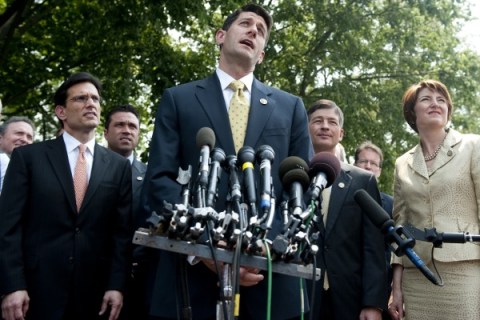
It’s a little hard to take seriously the Republicans trying to shame Obama and other Democrats out of vilifying Paul Ryan’s plan to overhaul Medicare. GOP lawmakers and candidates for office – although not Ryan primarily – spent 2009 and 2010 convincing the public that the Affordable Care Act would gut Medicare and even lead to “death panels.” (A recap: there are no death panels, the program retains its fundamental shape as a single-payer government system and cuts to Medicare called for in Obamacare, while significant and diverted to fund new subsidies for non-seniors, total about $500 billion over 10 years. The program’s annual budget is about $500 billion.) Yet, Republicans – stung by polling showing that the Ryan plan to transform Medicare into a much cheaper, privatized system is unpopular – are calling on Democrats to end their “Mediscare” campaign.
In a closed door meeting between Obama and Republican House members on Wednesday, GOP Whip Eric Cantor “pressed” the president to “stop the demagoguery,” according to Politico. A GOP aide familiar with the discussion said Ryan himself accused Obama of adopting a Medicare strategy solely focused on being re-elected in 2012.
The looming question is not whether Republicans will abandon the Ryan plan out of sheer self preservation or whether Democrats will stop accusing Republicans of selling out seniors or soon-to-be-seniors — Republicans do favor the philosophy of Ryan’s Medicare design and already voted in favor of Ryan’s budget, so it’s too late for them to turn back, and Democrats can’t pass up the low-hanging fruit of the Mediscare strategy. As Greg Sargent pointed out, the question that could determine which party will gain an advantage – or shed a disadvantage – is what kind of entitlement compromise, if any, Democrats agree to during deficit reduction negotiations this summer. Cede too much ground and agree to anything resembling major Medicare or Medicaid reform and Democrats risk losing their supposed high ground as the protectors of these programs. Republicans could scramble out from under the weight of the Ryan plan and say the plan was a starting negotiating point that ended up forcing Democrats to give in on entitlement reform.
There are some entitlement compromises Democrats might be able to live with without giving up their stronger public opinion position. Medicare means testing might be one such compromise. According to the GOP aide privy to the President’s meeting with House GOPers Wednesday, Obama said entitlements could be on the table, but indicated that federal cuts shifting costs to the elderly, poor or states would not earn his support.
Both parties are in a tough spot. If Republicans give up their ambitions to radically change Medicare – turning it from a government-run program into one in which seniors get subsidies to go out and purchase private insurance – they gain little. Most of them already voted for the Ryan plan anyway and won’t be able to run away from those votes. If Democrats strike a deal, they risk undermining their favorite political talking point. There’s always a chance entitlements are too much of a hot button to include in the deficit reduction deal that will be needed to pass the pressing debt ceiling increase. But there will be a 2012 budget to debate after that and, eventually, there will likely be another need to raise the borrowing limit. Sooner or later, Democrats and Republicans will need to learn how to speak each other’s language on entitlement reform.