

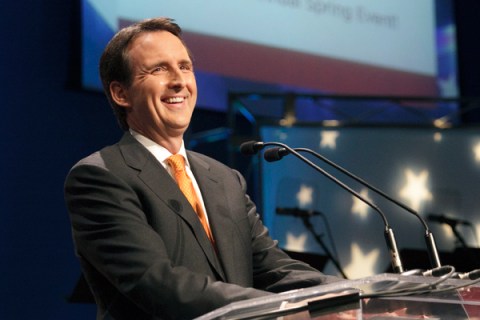
A few thoughts on Day Zero of the Tim Pawlenty for President campaign. First, Pawlenty is a serious candidate who, unlike many in the race, can actually be nominated. I put him in the current Gang of Three most likely nominees, along with frontrunner Mitt Romney and quirky upstart Jon Huntsman. Pawlenty won two gubernatorial terms in Minnesota, a very tough purple state. He is well organized and an aggressive campaigner. He occupies what I like to call the classic “understudy” slot in the field: a regular Republican who is perfectly acceptable to most of the party if a better known frontrunner implodes and none of the more atypical candidates catch on — think Lamar Alexander in 1996.
So, the question is: How can Tim Pawlenty go from unknown to nominee in seven months? It will not be easy. He must win a conservative primary, without abandoning the pragmatic style that made him appealing in a state outside the GOP base. He should avoid at all costs aping the identity gymnastics that so damaged Mitt Romney’s campaign in 2008. That is easier said than done. Looking at the early calendar, it appears that Pawlenty’s best option is to break through in the Iowa caucuses. The temptation to go palo-right in Iowa will be tremendous. Nothing is harder in an underdog campaign than turning away from easy immediate votes to protect a long term strategy. But Pawlenty should study the caucus geography carefully.
With fellow Midwesterner Mitch Daniels now out of the race, Pawlenty is the only “regular” Republican signaling he will full out compete in Iowa. There is a decent pile of regular Republican voters to be found there. (That will be especially true if Mitt Romney mostly stays out of Iowa. With Daniels gone, Romney’s Iowa strategy now requires a very tricky re-calculation.) For Pawlenty to get a real boost in Iowa, he needs to beat somebody with a bigger campaign than his; Herman Cain, Ron Paul, Rick Santorum, Gary Johnson and Newt Gingrich don’t count. And there’s a good chance that a movement conservative like Michele Bachmann could beat him for first place in Iowa. Competing in Iowa will also be expensive, and Pawlenty will find fund-raising very hard after he brings in the first $7-9 million. (See more on the pitfalls in Iowa here.)
That said, winning is never easy. Pawlenty will need a boost and engineering a high-profile Iowa victory is his best path. Without some help from Iowa, New Hampshire’s primary will be daunting. Mitt Romney already has a solid knot of support there and Jon Huntsman is working hard to recreate John McCain’s 2000 magic with the many independent voters who participate in the Granite State primary. Still, both front-running Romney and Huntsman have vulnerabilities. Pawlenty’s test will be emerging from both Iowa and New Hampshire as a perceived winner. If he achieves that, a thrifty, disciplined and strategic Pawlenty campaign could go all the way.
Mike Murphy is a Republican political consultant.