

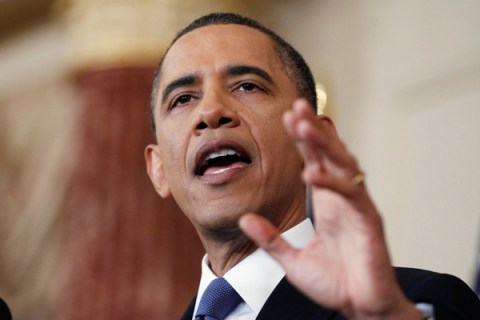
Listening to the commentary, you might think President Obama’s speech on Thursday was an important moment in Middle East history. It is a “hugely important speech,” said Wolf Blitzer on CNN in the run-up; Obama to “Reset” Middle East policy, declared U.S. News.
But in the coming months, the speech is more likely to look like a scramble by the White House to catch up with events in the region. Even when substance elbowed out rhetoric, Obama’s policy positions — on the Palestinian-Israeli peace process, economic support and human rights — struggled to keep pace with the challenges facing the region.
PHOTOS: Palestinians Mark Nakba with Violent Protests
Obama’s statement that the 1967 borders should serve as the basis for a Palestinian state is significant to some observers. That language has been the basis for two-state talks since the Clinton Administration, but no President has ever said it explicitly, out of deference to Israel’s negotiating position. But unveiling tacit agreements have had minimal effect on peace in the past. In 2007, George W. Bush declared what everyone already knew: that the U.S. supported the creation of a state called Palestine. His ensuing efforts at peace ended with a new war in Gaza.
The economic aid that Obama announced is sorely needed, but it will not shape the future of the region. Rather, it is a response to the past. New U.S. aid to Egypt will amount to nearly $2 billion. Aid from international financial institutions will amount to a similar amount or slightly more. But ever since January, when the uprisings in the region began, economies there have tanked. In Egypt, the economy is forecast to shrink by a figure between $3.75 billion and $6.2 billion this year alone, thanks to lost tourism and other disruptions. (See photos of Bahrain protestors in Pearl Square)
And on human rights, Obama’s tougher language on Syria — he said “the Syrian regime has chosen the path of murder” and touted newly announced sanctions — fell short of where his Secretary of State and Vice President have positioned themselves. Obama did not say that President Bashar Assad has lost legitimacy as a ruler.
These moves are not damaging. And it may have been better for Obama to make them than not. But the real criticism of Obama’s speech may be that each of these positions might have made a greater difference if they’d been staked out earlier.
That is particularly true of the Israeli-Palestinian fiasco. Obama spent two years focusing on a settlement freeze and resisted putting out any U.S. language on borders. Now, as Palestinians and Israelis careen toward confrontation this summer in the run-up to a unilateral declaration of statehood by the Palestinians in the fall, the effect of Obama’s declarations will be limited at best. (See photos of tempers flaring across the Middle East)