

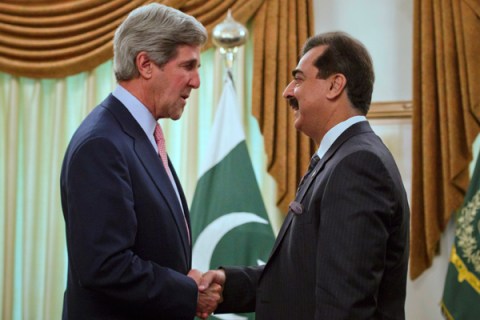
In recent years, John Kerry seems to have settled into a new role in the Senate. The 2004 Democratic presidential nominee finally got a major chairmanship at the helm of the Foreign Relations Committee. And he’s been in the thick of several major issues from climate change and health care reform to Afghanistan/Pakistan relations. It was Kerry who pushed through $1.5 billion in annual non-military aid to Pakistan. And so it was Kerry who went last week to tell Pakistan that if they don’t find a way to reset relations, all that money – plus $3 billion each year in military aid – could be at risk.
Kerry’s tone was striking. “I emphasized to my Pakistani friends that many in Congress are raising tough questions about our ongoing assistance to the government of Pakistan in light of the events of the past weeks,” he told reporters Monday before returning to Washington.
His comments marked a stark departure from what he was saying three weeks ago, when Kerry told me that the strident position taken by those like Senate Armed Services Committee Chairman Carl Levin, who threatened to cut off civilian aid, risked pushing Pakistan into the hands of Islamists. “To a certain degree, a lot of Pakistanis think we’re going to leave and so they’re hedging, and our own statements and policies contribute to their ambivalence,” Kerry said. If enough Pakistanis start to believe we’re going to pull out, he said, “it could get very significantly worse. You could wind up with an Islamist government that has nuclear weapons.”
Kerry’s carefully calibrated words at home and abroad – one timbre for U.S. politicians and another for Pakistanis – show how much his portfolio has expanded in recent years. It wasn’t long ago that the chairman of the Foreign Relations Committee really only worried about a domestic impact. Even Joe Biden, Kerry’s predecessor, rarely conducted as many direct AfPak negotiations as Kerry has in the last three years. It was Kerry who convinced Afghan President Hamid Karzai to allow run off elections in 2009. And it was Kerry who secured the release of C.I.A. contractor Raymond Davis earlier this year after he shot and killed two Pakistanis in Lahore. On his latest trip, Kerry secured the return of helicopter parts abandoned at bin Laden’s Abbottabad compound and seized by Pakistani authorities. And before leaving, Kerry told reporters that he was laying the groundwork for Secretary of State Hillary Clinton to announce her upcoming visit to the region — an unusual role for someone acting outside the official capacity of the State Department.
Many speculate that Kerry is developing this new voice because he hopes to make it his full time job. Clinton has already said that she’ll be leaving Foggy Bottom after the 2012 elections. Kerry interviewed for — and very much wanted — the job of Secretary of State in 2008. This time, he seems to be the frontrunner to fill the spot after Clinton’s departure. Certainly, in the wake of Richard Holbrooke’s death – and even before it as Michelle Cottle reports – Kerry has taken the lead on AfPak diplomacy. As U.S. troops begin to withdraw from Afghanistan this year and relations with Pakistan hang in the balance, Clinton’s successor must be steeped in the politics and policies of the region. Few are more qualified, or more eager, than Kerry.