

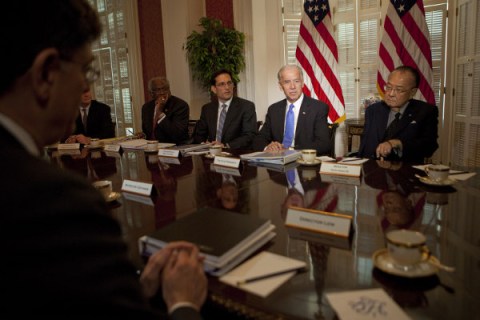
After meeting for two hours Thursday, the latest lawmakers to be tasked with solving the budget puzzle emerged from Blair House with Opening Day optimism. Vice President Joe Biden called it a “good, productive” session. “We had a good rapport develop,” said Eric Cantor, the House Majority leader. What did they accomplish? Apart from announcing they’d be meeting again, the negotiators weren’t saying.
So it goes with Washington’s byzantine budget negotiations, where progress often means agreeing to get things done some other time. It’s hard to know whether Biden’s bipartisan commission will become the key to a deal or the latest in a string of theatrical summits. “[Biden] is the only game in town anymore,” a Senate Democratic aide told the Huffington Post. But what President Obama envisioned as a 16-member group has dwindled to a cast of six–and they’re hardly the guys you’d pick if you wanted to broker a pact. As recently as last month, political observers were touting another so-called Gang of Six as the best hope for a budget deal — the bipartisan group of Senators led by Budget Committee chair Kent Conrad. By now, the glacial pace of their negotiations may have consigned them to irrelevance; Politico on Thursday lampooned the concept of bipartisan commissions as a quaint relic, “as outdated in the hyperpartisan capital as a horse and buggy.” Conventional wisdom can shift at warp speed.
If anyone can tease out an agreement, it’s Biden, who has emerged as Obama’s preferred point man for repairing frayed negotiations. The former Senator helped hammer out a tax deal during last December’s lame-duck session and helped avert a government shutdown last month. Some time before August 2 – the sooner the better, so as to avoid spooking skittish markets – Congress needs to raise the $14.3 trillion federal debt limit. And while Democrats have urged a “clean” vote to do so, they will almost certainly have to hand Republicans some form of spending cuts in order to avoid dealing a “catastrophic” setback to the U.S. economy, as Treasury Secretary Tim Geithner has warned.
At the top of the Blair House meeting, Biden also stressed the “much larger, looming issue of the long-term debt.” Some moderate Democrats—notably, those up for re-election in 2012—are joining Republicans in insisting that spending cuts accompany a debt-ceiling hike. The White House accepts this. The entire budget brouhaha boils down to what form those cuts take.
Republicans say their support for Paul Ryan’s budget blueprint hasn’t wavered in the face of the stiff criticism some constituents leveled during the Congressional recess. But Ryan himself admits that Republicans are unlikely to hit a “grand slam” by immediately slashing entitlement spending. Dave Camp, the Republican chair of the House Ways and Means Committee, said he was unlikely to hold hearings on Ryan plan’s goal of privatizing Medicare. “I’m not really interested in just laying down more markers,” said Camp. “I’d rather have the committee working with the Senate and the President, focusing on savings and reforms that can be signed into law.” Even Cantor appeared to tell the Washington Post that his plan for Medicare reform was basically off the table, before backtracking to insist that the conference was still wedded to it.
This confusion reflects the party’s struggle with an existential question: Should Republicans dig in their heels and demand something they know they won’t get, or pursue smaller, more realistic goals? GOP lawmakers know the consequences of failing to raise the debt limit would be immense. They’re not eager to wreak havoc on financial markets and set back the shaky recovery by engaging in the kind of brinksmanship that won them concessions during the last round of negotiations. So while some Republicans say they’ll hold out for a balanced-budget amendment and comprehensive entitlement reform, the vast majority of Republicans are bracing for another bargain. “Everyone realizes this has got to be done,” says a House GOP aide. “The things we really want aren’t going to happen, at least right now. If all you ever do is pass things through the House, the status quo stays the same. Boehner’s shop has been pounding that into the rank and file.”
Cantor has said that Republicans will insist on cuts in the 2012 budget and statutory caps on future spending. The framework for a deal, a Republican aide suggests, could also include some combination of reducing spending to 2008 levels and an overhaul of the tax code, an issue on which both parties believe they can find common ground. On Thursday, Ryan suggested targeted caps alone wouldn’t be enough and the GOP wanted a “down payment” on spending cuts. The size of that down payment remains undetermined.
If Republicans are feeling their way forward, the Democratic position remains somewhat opaque. In his speech on economic policy last month, President Obama stressed the need for deficit reduction and floated a “debt-failsafe trigger.” But the address was often vague on specifics. On the eve of the Blair House summit, the two Republican emissaries – Cantor and Senate Minority Whip Jon Kyl – sent Biden a letter requesting a “detailed proposal” from the President that the Congressional Budget Office could score. “Any increase in the statutory debt limit must be accompanied by meaningful and immediate spending reductions and binding budgetary reforms,” they wrote.
As always, taxes will be a sticking point. Democrats want to raise rates on the rich and slash subsides to oil companies; if they’re to agree to broader tax code reforms, they’ll want to see a net increase in revenue. “Revenue has to be a part of this discussion. That has been the verdict of every bipartisan group that has taken a serious look at the situation,” Biden commission member Chris Van Hollen, the ranking Democrat on the House Budget Committee, told Bloomberg TV Thursday morning. But for the vast majority of Republicans who’ve pledged never to raise taxes, that would fly in the face of orthodoxy.House Speaker John Boehner declared that “nothing is off the table except for raising taxes.”
It’s a good thing that Thursday’s kickoff session had a feel-good vibe. But the parties have a long way to go.