

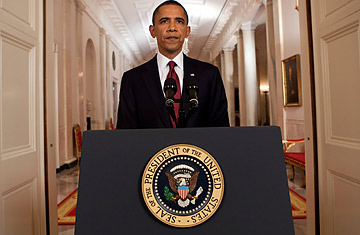
Shortly after hearing confirmation on Sunday that Osama bin Laden was dead, President Barack Obama walked down to chief of staff Bill Daley’s West Wing office to discuss what he would say in his address to the nation.
The President had already mapped it out, even if his speechwriter had yet to start typing. The speech would begin by recalling the images of Sept. 11, 2001. It would run through the events of the night. And it would end with a call to American greatness, a celebration of the idea that the U.S. can do anything. In short, he wanted to revisit the refrain from his 2011 State of the Union: “We do big things.”
“Today’s achievement is a testament to the greatness of our country and the determination of the American people,” he told the world hours later, after going through several revisions of a draft in the Oval Office with his speechwriter. “The cause of securing our country is not complete. But tonight, we are once again reminded that America can do whatever we set our mind to.”
In that moment, the President was trying to illustrate a larger theme, one beyond the scope of al-Qaeda or the war on terrorism. He was restating the central political message of his nascent re-election campaign, which is centered around the idea that Obama is the person best able to bring the nation out of its decade-long malaise to win the future.
Obama has discussed this thematic connection with his aides in the West Wing, explaining that the death of bin Laden signals something far greater than a national-security accomplishment. “He views this as a demonstration of this country’s capacity to overcome skeptics and do things that people had decided were no longer doable,” explained press secretary Jay Carney in an interview on Monday afternoon. “There is sort of a grit and resolve. And not in a John Wayne way, but in a commitment and focus.”
In his explanation, Carney was seeking more political distance between Obama and his predecessor, George W. Bush, who often evinced a cowboy attitude — Bush once famously said he wanted bin Laden “dead or alive.” Since bin Laden’s death early Monday in Pakistan, White House aides have made a point of noting Obama’s disappointment with the state of the bin Laden manhunt when he took office in 2009. On June 2 of that year, Obama issued a memo calling for a reinvigoration of the hunt for bin Laden. White House aides say that directive led to more equipment, manpower and focus for the effort.
In his speech on bin Laden’s death on Sunday, Obama gave Bush no credit for the key intelligence gathered by his Administration, which paved the way to Abbottabad. Rather, Obama mentioned Bush simply to agree with the former President’s contention that the U.S. is not at war with Islam.
This political positioning comes at a time when Obama is striving to appear above politics. At a previously scheduled bipartisan dinner with congressional leaders on Monday night, Obama said the killing of bin Laden had brought the country together once again. “I think we experienced the same sense of unity that prevailed on 9/11,” he said in brief remarks. “We were reminded again that there is a pride in what this nation stands for, and what we can achieve, that runs far deeper than party, far deeper than politics.”
Obama plans to take that message on the road later in the week, traveling on Thursday to the site of the former World Trade Center to commemorate bin Laden’s death with a remembrance of the Americans who died there. The event is sure to draw further comparisons to Bush, who declared at that site a few days after the 9/11 attacks that “the people who knocked these buildings down will hear all of us soon.”
In addition to fighting wars and signing budgets, U.S. Presidents are tasked with telling the national story in times of tragedy and victory. For Obama at this moment, the story is about a nation coming out of a long decade of decline and frustration. It is a story of a President leading the country back to greatness, and it is the platform on which Obama’s re-election campaign will be built. Osama bin Laden is now a central figure in that story, playing a major role for a second U.S. President in yet another re-election campaign.