

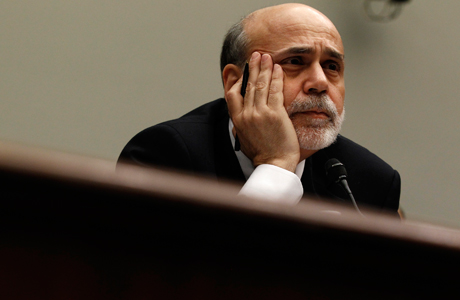
If Federal Reserve chairman Ben Bernanke had a tank, I wouldn’t just be in it; I’d probably be the bouncer checking ID’s at the door. I wrote the 2009 Person of the Year profile that credited him with saving the global economy. I made the case for his confirmation for a second term, comparing the left-wing and right-wing politicians who opposed him to accident victims who get rescued with the jaws of life and then complain that their rescuer broke a window. I defended his “QE2” bond-buying spree when inflation hawks were mocking him as Helicopter Ben and Zimbabwe Ben. I’ve described Bernanke as the most transparent Fed chairman ever—which, granted, is a bit like being the most intelligent Real Housewife ever—and I think it’s really cool that on Wednesday he’ll hold the first press conference in Fed history.
So here’s my first question: Mr. Chairman, are you failing?
Maybe I should put it like this: Mr. Chairman, why are you failing?
This might get me kicked out of the tank, but the U.S. economy is still terribly weak, and it’s still Bernanke’s economy. The Fed has a dual mandate to stabilize prices and maximize employment; prices are stable, but 8.8% unemployment is just outrageously, tragically high. It’s a national emergency, an egregious waste of human capital, and Bernanke needs to explain why he isn’t doing more about it. Yes, he’s already done more than any chairman has ever done and then some. But he hasn’t fixed the problem, so he ought to do even more, or else say why he can’t.
Bernanke and I had this discussion for the first time 18 months ago in front of my irritated and impatient bosses. He made it as clear as any Fed chair could that while he considered sky-high joblessness a disaster, he didn’t plan to do anything else about it. Interest rates were already as low as they could go. The Fed balance sheet was already bloated beyond belief. He had already blasted trillions of dollars into the economy, and hawks were clamoring for him to shift from loose employment-boosting policies to tight inflation-fighting policies. At the time, he suggested to me that additional monetary stimulus probably wouldn’t help much, and could conceivably make things much worse by denting the Fed’s anti-inflation credibility, even though the only traces of inflation on the horizon were in the fevered imaginations of his hyperventilating critics.
I was a bit skeptical, but I figured that Bernanke had earned the benefit of the doubt. And when the economy remained stagnant for another year, he did step on the gas a bit with QE2. But that’s going to end soon. Unemployment has dropped for four consecutive months, and a tepid recovery is definitely better than the epic depression we could have faced if Bernanke hadn’t saved the world. But while the recovery has worked out wonderfully for Wall Street, and corporate profits are booming, families in struggling communities like his hometown of Dillon, S.C., are still struggling, and he’s still the guy in the chair. Back when he was an academic, he criticized Japan’s central bank for its inaction in a similar situation.
He may believe that there ain’t much more the Fed can do. He may believe that injecting more monetary stimulus would be like pushing on a string, that giving already-liquid banks additional liquidity and driving down already-low mortgage rates even lower would sidestep fundamental problems of consumer demand and business confidence. He may believe that the potential costs of freaking out hawks at a time when the dollar is already weak and the deficit is already astronomical would outweigh the potential benefits of juicing the economy. If he thinks he’s finally out of bullets, he should say so.
And then I’ve got a follow-up question, which I’ll get to in a follow-up post, since I’m not sure the new bouncer for Bernanke’s tank will let me ask him directly.