


Republican gains in last November’s Congressional elections were minor compared to the rout the party engineered in statehouses around the U.S. The GOP won a net gain of nearly 700 state-legislature seats on Nov. 2, wresting away control of 19 chambers. It was the biggest landslide in decades, dwarfing the “Republican revolution” of 1994. “As we enter a time with huge policy and political implications,” Ed Gillespie, chairman of the Republican State Leadership Committee, wrote in a congratulatory note Nov. 3, “new Republican officeholders will be given an opportunity to demonstrate common-sense conservative leadership and implement solutions that promise real results and positive change.”
Since then, however the party has marshaled its manpower in state capitals to advance a conservative agenda that goes far beyond its stated goal of creating jobs. The battle over public-sector unions in Wisconsin was the first in a nationwide war over local government wages, pay and bargaining rights, with fronts in more than 20 states, including Indiana and Michigan. A number of other states have pushed to limit abortions. Thirty states have considered omnibus bills cracking down on illegal immigration, according to the bipartisan National Conference of State Legislatures (NCSL).
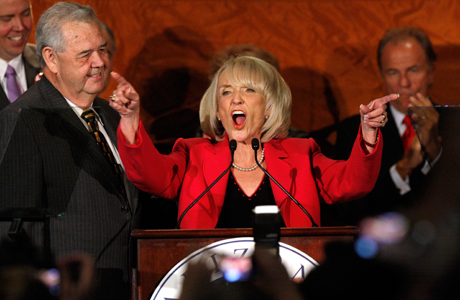
The march to the right in the states was punctuated Monday, when Arizona’s conservative Governor Jan Brewer vetoed two controversial bills—one requiring presidential candidates to furnish a birth certificate, the other to loosen gun laws on college campuses, just months after a troubled student’s killing spree in Tucson.
Some of that action, however, bears little resemblance to the “common-sense…solutions” Gillespie urged. Leery of the powers of the Federal Reserve, a handful of states have mulled measures that declare gold or silver legal currency, and Utah’s governor signed one into law on March 25. Other states, like Wyoming and Tennessee, have fielded legislation barring courts from weighing Islamic sharia or foreign law. In addition to Arizona, 14 states have considered so-called “birther” bills that require presidential candidates to produce various proofs of native origin, though none have been enacted so far. More than 20 have pushed state-sovereignty legislation–efforts to declare themselves sanctuaries from EPA regulations, for example, or to exempt themselves from “ObamaCare.” At least seven have introduced measures that support the teaching of creationism in public schools.
The flurry of social legislation may be partly a function of making up for lost time. Republicans regained control of a number of states that, despite conservative leanings, had been Democratic redoubts; in Alabama, for example, the GOP snatched back a statehouse that had been under Democratic control since the 1870s. “It’s stunning how radical Republicans have been in the states,” says Michael Sargeant, executive director of the Democratic Legislative Campaign Committee. “These are things conservative groups have been working on for a long time, and now that they have the opportunity they’re pushing this despite the public outcry.”
If there’s a silver lining, Democrats say, it’s that voters in moderate states could punish the GOP for overreaching. “This has exposed what their agenda really is,” says Sargeant. “When Jan Brewer is vetoing bills in Arizona, it makes you realize how far Republicans have gone.”
But with so many Tea Party-powered legislators eager to dial back Democratic policies, this may just be the start. The same day as Brewer’s vetoes, Kansas Governor Sam Brownback signed a bill requiring voters to provide a photo ID at polling places, which critics say will suppress turnout. Statehouses provide a venue to advance conservative causes that often go nowhere inside the Beltway. “State-level action,” says Michael Boldin, founder of the Tenth Amendment Center, which promotes state sovereignty, “is far more effective than anything that happens in Washington.”