

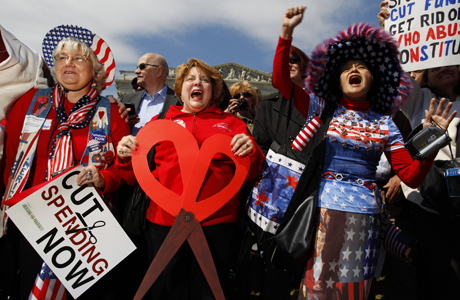
Can we all agree that the Tea Party brand is effectively kaput for the 2012 Republican primary? That’s not to say that you won’t hear it repeated over and over again, in polls, newspaper headlines and in advertisements for rallies and debates. “Tea Party” is to Republican politics what “diet” is to snack food. Don’t trust the label. It can still make you fat.
Back in 2010, the Tea Party, though diffuse, came to stand for something. It was a populist movement of fiscal conservatives angry at President Obama and upset at the institutional Republican Party. It nominated mavericks in a string of primaries that sent a small class of next-generation, pure-bred ideologues to Congress. But there was never any clear definition about what made something “Tea Party.” Pollsters and reporters scrambled to understand a movement of self-described people lacking a leader or a manifesto.
Enter the 2012 Republican primary season. Every one of the semi-declared candidates in the field want to claim a part of the Tea Party mantle as their own, and everyone has a slightly different definition of just what that mantle means. In the meantime, pretty much every candidate in the race has a reason to claim Tea Party support. In one poll, Mitt Romney, of RomneyCare fame, leads among Tea Party voters. Then Tim Pawlenty is winning a Tea Party straw poll in New Hampshire. So is Herman Cain; Ron Paul and Chris Christie win them too.
And then there is Trump. Who better typifies fiscal conservatism than a big spending billionaire who previously embraced single-payer health care and proposed a 14.25% net worth tax on everyone with more than $10 million to their name? As the head of the Club for Growth says of Trump today, “His love for a socialist-style universal health care system and his alarming obsession with protectionist policies are automatic disqualifiers among free-market conservatives.”
Which is why, of course, news organizations across the country are trumpeting the great Trump victory over the weekend when he appeared at a Tea Party rally in Boca Raton, Fla., as a “crowd pleaser” who faced spontaneous chants of “Run, Trump, Run.” (C-Span has captured the remarks here, for those who did not get enough Sunday night when Trump fired Gary Busey on the Celebrity Apprentice, the latter event about as consequential as Lady Gaga not wearing pants, except with more pants.)
In short, anyone and everyone is “Tea Party.” The term is open-sourced. And though it will continue to be used over the coming months as a short-hand for the populist, unsettled upsurge in the Republican Party, it will mean less and less. Barring a third party run, there is unlikely to be a single Tea Party candidate because most candidates will claim Tea Party support, and since Tea Partyers in Iowa will have a different set of self-defining traits that Tea Partyers in New Hampshire. Your Tea Party is not my Tea Party. His Tea Party is not her Tea Party. We are all Tea Party, and none of us are Tea Party, because the Tea Party is everywhere, and as a result, nowhere in particular.