


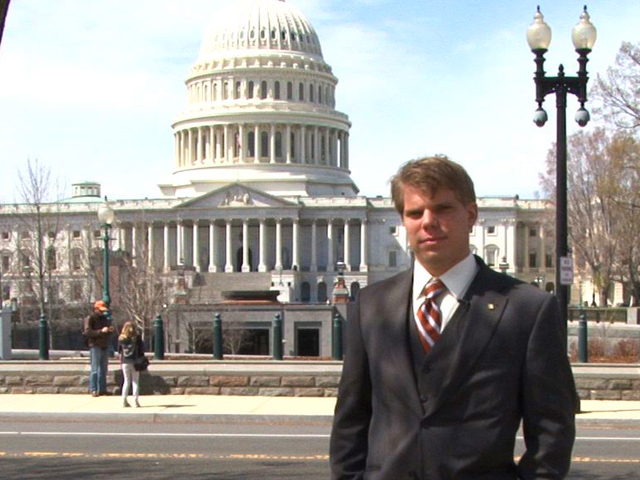
Iraq veteran John Kamin on Capitol Hill. (Natasha Del Toro)
March’s jobless numbers, released Friday, offer some hope of a rebound in the labor market, but things aren’t so easy for Iraq and Afghanistan-era war veterans.
According to the Department of Labor statistics, the unemployment rate for those returning soldiers in 2010 was 11.5%, compared to 9.7% for non-vets. And while the overall metrics are improving, veterans’ plight is actually getting worse. So far this year, their jobless rate climbed to 15.2 percent in January and 12.5 percent in February.
That’s why two dozen veterans from the across the country stormed Capitol Hill this week to meet with members of Congress. Their mission: to lower the unemployment rate by the end of the year by pushing a jobs bills package targeted specifically at veterans.
It’s part of a campaign by the Iraq and Afghanistan Veterans of America (IAVA), a non-profit organization that advocates for veterans’ issues. “If you want to support the troops, support veterans, hire them,” said Paul Rieckhoff, IAVA’s founder and executive director.
The legislative package includes job training and transition assistance for vets, tax credits for employers that hire vets and a comprehensive study of how military skills translate into civilian jobs.
Eric Smith, a former navy corpsman, says that last piece is really important. As a medic in Iraq, he routinely treated soldiers injured by improvised explosive devices (IEDs). Smith has saved lives. But since he returned to Baltimore in 2008, he’s only been able to land odd jobs like bartending and day labor. The 30-year-old lives at home with his parents. Smith, who dropped out of high school and joined the Navy at 17, says he has applied at local hospitals but doesn’t have the proper certification to work as a medical assistant or EMT. “They are always really impressed with my experience, but they don’t hire me because I don’t have the paperwork to prove my skills,” he says.
That’s only one of the challenges vets face. The employment situation is even worse for Reserve and National Guardsmen, whose jobless rate was 14 percent in July 2010. Advocacy groups say many employers discriminate against reservists because of the possibility of recall, which can disrupt work.
Getting dismissed or demoted because of redeployment is a violation of the Uniformed Services Employment and Reemployment Rights Act (USERRA), which protects reservists and National Guardsmen from losing their jobs. But that doesn’t mean it’s not happening.
“Some employers don’t know the law,” says Rieckhoff. And many veterans themselves don’t know they have protections under the law either. Enforcing USERRA is another policy agenda for IAVA.
Then there is the stigma of PTSD. Some employers are afraid of the “Rambo Effect,” says Rieckhoff. IAVA is launching an Ad Council campaign to combat misconceptions.
John Kamin, who returned in December from his second tour in Iraq, where he served with the Louisiana National Guard, says the country is wasting soldiers’ skills and sacrifice. Making his own trip to the Hill, he recently met one-on-one with Democratic Senator Dick Durbin, who has pledged to support IAVA’s efforts.
“This isn’t about accolades, this isn’t about ticker-tape parades, this isn’t about self indulgence,” says Kamin. “This is about identifying what people have gone through and making investments in what they can further give.”
But employers don’t seem to be recognizing that. Rieckhoff says some veterans avoid ever mentioning their service to a potential employer because they fear it’s more of a liability than an asset.