Why The Deficit Commission?

The president’s “National Commission on Fiscal Responsibility and Reform,” chaired by Democrat Erskine Bowles and former Republican Senator Alan Simpson, held its first official meeting this morning at the White House. Speaking about the endeavor, Obama pointed to the challenges financial crisis and economic downturn thrust on the government and the necessities of the stimulus before pivoting to the importance of restoring PAYGO, bragging about his proposed discretionary spending freeze and plans to cut waste. And then he acknowledged the hard truth: Those things don’t amount to diddly. (Well, OK. He said, “All these steps, while significant, are simply not enough,” but you get the idea.)

Pretend for a moment the bipartisan deficit commission made unprecedented proposals that blew the most ballyhooed budget complaints out of the water. They could recommend constitutional amendments banning government bailouts, Keynesian stimulus and congressional earmarking outright. They could eliminate all non-military foreign aid, put a permanent cap on defense spending at current levels, outlaw future tax cuts or close every tax exemption on the books. All of these things are politically unfeasible, many of them are ill-advised and none of them will ever happen. But let’s pretend. After all that, America’s long-term fiscal outlook would still be dim. Here’s why:
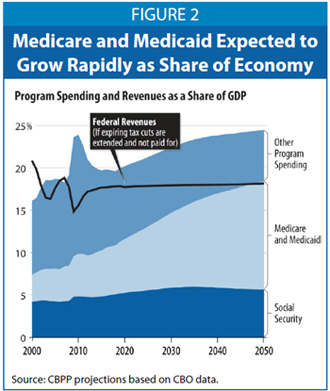
That graphic is from the Center on Budget and Policy Priorities and its trend line shows that Medicare, Medicaid and Social Security costs will catch up to the entirety of federal revenue as a percentage of GDP in coming decades if things don’t change. Addressing the problem is not as simple as entitlement reform — the two main factors at play in the explosion of Medicare and Medicaid costs are health care inflation and an aging population; finding out which cost controls from the new health care law work and aggressively applying them could dramatically change the picture. But the more straightforward revenue vs. expenditure considerations for Medicare, Medicaid and Social Security are still bound to be part of any serious discussion of long-term deficit reduction.

Now to the politics. There is simply nothing more politically toxic than this issue. When Democrats proposed cuts to Medicare Advantage — a program that gives money to seniors to buy private insurance rather than covering them under Parts A and B — as part of the the health care overhaul, the GOP cried bloody murder. When Republican Paul Ryan proposed his fiscal “Roadmap,” Democratic Rep. John Larson said its proponents were “frozen in the ice of their own indifference.” The merits of these policies aside, it’s clear that any discussion of the big three entitlements is given to reactionary hyperbole.

What about raising revenues? On April 6, White House adviser Paul Volcker, responding to a question about the feasibility of a value-added tax, said a VAT “was not as toxic an idea” as many supposed and that, “If at the end of the day we need to raise taxes, we should raise taxes.” He was decidedly wrong about that first part. A firestorm of angst ensued and, less than two weeks after Volcker’s comments, the Senate passed a purely symbolic “sense” amendment by a whopping majority of 85-13 stating the upper chamber would oppose any move to institute a VAT. One more political sticking point: During the campaign, Obama pledged not to raise taxes on families making less than $250,000 per year. It’s easy enough for critics to argue a VAT, levied on producers of goods who in turn pass that cost on to consumers, breaks his pledge. For the more rhetorically unhinged, there’s always this: Most European countries use a broad-based consumption tax like the VAT instead of more heavily taxing income as the United States does. If you thought cries of “European Socialist” were loud during the health care debate, just you wait until Comrade Simpson and Comandante Bowles propose new revenue streams.

Perhaps the central political challenge of serious deficit reduction is that there’s only one easy villain. Health reform had profit-obsessed, claim-denying insurers. Financial reform has mortgage-swindling, economy-tanking fat cat Wall Streeters. With budget matters, there’s no foil for reformers to play against. People love their government goodies and hate paying for them, plain and simple. Whoever tries to raise taxes or cut entitlements quickly becomes the monster. And that’s why presidents try to shield themselves with bipartisan commissions — the recommendations provide a way to argue for change without being the progenitor of unpopular policy. George W. Bush had to use “The President’s Commission to Strengthen Social Security” in his privatization push. Bill Clinton and the Republican Congress needed the “National Bipartisan Commission on the Future of Medicare” before touching said program in the late ’90s.

And that brings us back to Simpson and Bowles. Today, in an interview with MSNBC’s Andrea Mitchell, the pair’s purpose was on display. After recounting how his own mother begged him to keep his hands off Medicare, Bowles said, “We have to touch Medicare. We have to touch Social Security. We have to touch the military. And we have to take a strong look at revenue.” Simpson agreed, “Everything is on the table.” The commission is scheduled to report its findings in December. That’s when we find out what made it from the table to the chopping block.

Related Topics: alan simpson, deficit reduction, erskine bowles, medicaid, medicare, Taxes, Barack Obama, Uncategorized, White House
  • Latest on Swampland

    Craig Warga / NY Daily News via Getty Images

    Birth Control Debate: Why Catholic Bishops Have Lost Their Grip on U.S. Politics—and Their Flock

    The clash with the White House over birth control is a reminder of just how much influence the U.S. Conference of Catholic Bishops has lost in the 10 years since the child sex abuse crisis erupted in America.

    Romney: I Was A 'Severely Conservative' GovernorHuffPost Politics

    Obama to Submit His Budget to Congress on Monday

    President Barack Obama is pressing for investments in infrastructure while relying on familiar tax increases on the wealthy and corporations to claim progress on the federal deficit in his upcoming budget.

  • FlownOver

    Way to go, Captain Bringdown.

  • http://www.inworldstudios.com jayackroyd

    So I come back, and find the Village drivel still dominates.

    Why would you freeze military spending at current levels? What is radical about that? What we need are cuts on the order of fifty percent, elimination of occupying troops, in Japan, in Germany, in North Korea, in Iraq, in Afghanistan, in the thousand odd other bases.

    Why would you say “no more tax cuts?” Raise taxes. Eliminate loopholes. Bring us back to Reagan era progressivity, and reestablish the base broadening of Bradley Gephardt. Drop the cap on FICA. Eliminate special breaks like the 15% rate for hedge fund managers.

    There IS a problem in medical care costs. But that is not a Medicare or Medicaid problem. That is a cost containment problem. France delivers services for half of what the US does, and obtains better results. Just do what they do.

    In point of fact,this is entirely political. Introducing Medicare cuts as a means to keep funding the top 10 percentile earners access to the Treasury is profoundly dishonest. That will not fix the health care cost problem.

    In fact,everything is not on the table. The idiotic TSA is not on the table. The military is not on the table. Extremely expensive, opaque outsourcing of services to private industry is not on the table. Anything involving corruption is not on the table, and much of the fiscal problems we face are tied back to a profound degree of corruption.

  • http://phd9.blogspot.com Paul Dirks

    Thanks,
    This was the best reporting on the topic I’ve seen in a while. The actual problem is unfortunately inherent in human nature and exasberated by Democracy. Everybody wants something for nothing.

    I’ve always held that part of the problem is the very size of the Federal Government muddies economic thinking. Once the numbers people think about get large enough, they start feeling like infinity and the simple rules of addition and subtraction no longer apply. Perhaps people could get behind shifting significant expenditures back to the States IF they could also agree to stop treat taxes as if they were nuclear waste.

  • newfreedomblog

    My God, I agree with jayackroyd. Hell is surely going to freeze over.

  • jbaustian

    (quote)When Democrats proposed cuts to Medicare Advantage — a program that gives money to seniors to buy private insurance rather than covering them under Parts A and B — as part of the the health care overhaul, the GOP cried bloody murder. (end quote)
    .
    The reason for this was because the Dems pretended to find offsettiing cuts in Medicare that would (supposedly) make the HCR bill revenue-neutral. Addionally, they claimed to find $550 billion in total Medicare cuts. In fact everyone knows that the Dems will be back later this year to reverse the cuts — they do not want to face senior citizen voters in November with excuses for why they cut so much from Medicare.
    .
    Lastly, medical savings accounts are one of the few ideas that can actually cut total health care spending, because it provides incentives to patients, doctors, and hospitals. The doctors and hospitals can charge less because they do not have to wait for reimbursement, while the patients have incentive to skip unnecessary procedures.
    .

  • jbaustian

    Jay wrote: “Why would you freeze military spending at current levels? What is radical about that? What we need are cuts on the order of fifty percent, elimination of occupying troops, in Japan, in Germany, in North Korea, in Iraq, in Afghanistan, in the thousand odd other bases.
    Why would you say “no more tax cuts?” Raise taxes. Eliminate loopholes. Bring us back to Reagan era progressivity, and reestablish the base broadening of Bradley Gephardt. Drop the cap on FICA. Eliminate special breaks like the 15% rate for hedge fund managers. (end of quote)
    .
    I asked this question the other day, when someone called for more base closures: Name one base, anywhere in the world, that is not essential. I answered my own question, suggesting that there might be one or two small ones remaining in the former West Germany. Other than there, can you name any others?
    .
    As for taxes, I can propose a comprehensive tax reform system that would generate just as much revenue, that would close all loopholes, and that would cost far less for compliance. You mention Bradley-Gephardt, I liked Bradley-Gephardt, I thought it was a good first step, or actually a good second step after Kemp-Roth. But too many people on your side, starting with Bill Clinton, went back to raising rates and establishing new loopholes.

  • http://phd9.blogspot.com Paul Dirks

    What are we defending Germany from?
    Oh yeah, we’re defending them from the need to defend themselves.

  • newfreedomblog

    How about we not only stop spending, but cut spending in ALL programs by the 50% mentioned. Then abolish the IRS, and implement an across the board 15% VAT or a 15% individual income flat tax. Whatever you make in gross income, fork over 15%, period. No marriage deductions, no deductions period. No more loop holes for businesses and the mega rich who also need to buy things to run their companies the same as we individuals buy things for our home. No more big money Wall Street fat cats who pay less income taxes than their Secretary does.
    .
    If we do not do this quickly and now, Greece will look like a little economic blip in the world economy.
    .
    Harrisburg Pennsylvania is already considering bankruptcy.
    .
    Bernake is saying “the time is not far away when interest rates will begin to sky rocket.
    .
    Orzag has finally admitted the deficit last year, and the projected deficit this year will add an additional 2 trillion to the now 14 trillion dollar deficits. Orzag stated today that with the current deficits we can no longer sustain any economic growth.
    .
    With Greece basically declaring bankruptcy today, the stock market fell 1%. Better pull you money out now while you still have some people. It’s all going down over the next 6 months. Can anyone say C-R-A-S-H.

  • shepherdwong

    “Everybody wants something for nothing.”
    .
    Everybody’s been told for thirty years that the only problem is that taxes are too high and government is too big. Stupid in, stupid out.

  • lcky9

    Here’s the problem.. IF the government had not USED Social Security for things it was NOT intended such as SSI this money goes not to just those who WORKED and paid into the system if they were hurt on the job but to druggies who never worked, parents of kids with disabilities who felt that they were due the money to provide shelter, food and clothing for their kids from birth to 18 when the check then goes to the disabled grown child.. Basically that means the government has taken the money out of SS to provide birth to grave for these kids..(this is a fact I have a friend who collected over $1000 a month plus medical and food stamps while she and her husband both worked 40 hours a week as waitstaff where they didn’t have to claim all their money).. there was still money in SS until the government seen it and dropped in IOU’s and used it for OTHER social programs.. now those that paid in YES expect it back as promised.. same with medicare which by the way you PRE-PAY into the entire time you work than pay $100 a month out of your social security check.. so IF they are having a problem it’s because they also gave that out to those that NEVER paid into it.. What we have here is Propaganda from the top to make it like seniors are taking advantage of the system when it’s the system that took advantage of them.. I know while I can’t collect for awhile I didn’t request the money be taken from my check..but took it they did.. BTW I heard that is how Clinton brought down the debt with the money in SS.. Guess what now they will be doing the same with HEALTH CARE.. feel better now.?

  • http://jcapan.wordpress.com jcapan

    Jay, good to see you. John Feffer (FPIF) has a pretty good take on global base closures:
    .
    http://www.atimes.com/atimes/Japan/LC06Dh01.html
    .
    Not sure I share his sense of optimism but worth a read. The Futenma drama plays out every single evening on the news here. To watch this nation’s leaders grovel before the US hegemon is discouraging to say the least.

  • michaelfury

    “We have to touch the military.”

    Before it touches you.

    http://michaelfury.wordpress.com/2009/11/11/forever-war/

  • square1

    Does Adam Sorenson really not understand that Social Security has absolutely nothing to do with the deficit?

  • Cliff

    In fact everyone knows that the Dems will be back later this year to reverse the cuts
    .
    Hmmm. Pretty suspicious. Do you have any evidence for this “everyone knows” business?

  • FlownOver

    Once a blogwhore, always a blogwhore.

  • stuartzechman

    Well said, Jay.

  • stuartzechman

    At least he identified the problem with Medicare & Medicaid as “inflation”.

  • jbaustian

    jcapan, it is regrettable that Okinawa is located where it is, and unfortunate for the people of Okinawa that the US no longer has bases in the Philippines. With Subic Bay Naval Base and Clark Air Force Base no longer available, that makes Okinawa just too strategic for the US to leave. Guam is too far away. It is already a long haul from Okinawa to Singapore, and would be impossibly long from anywhere on Honshu or Kyushu..
    .
    Marines are, by definition and design, a fast-reaction force. They cannot react quickly to any threat in the region if they are based on Guam or elsewhere a thousand miles or more further to the east of Okinawa. There are already Marines at Iwakuni near Hiroshima, very nearly the closest point to Korea, but that’s a densely-populated area and there is no room to expand the air base there.
    .
    If you can think of another alternative, I would like to hear about it and the Pentagon would like to hear about it.

  • http://jcapan.wordpress.com jcapan

    jbaustian,
    .
    Seems like it’s a moot question now:
    .
    http://search.japantimes.co.jp/cgi-bin/nn20100428a2.html

  • Art Pepper

    But Figure 3 from the same site is even more interesting.

  • Art Pepper
  • http://www.inworldstudios.com jayackroyd

    What are we defending Germany from? says Dirks.
    .
    Originally the bases there and in South Korea were hostages, guaranteeing that the US would respond to an attack. (Poland’s fate was fresh in European minds.)

    Now it is just inertia and graft that keeps them there. Germany does serve as a staging area for attacking the middle east, but,of course, attacking the middle east also involves a great deal of graft. and cannot be justified in any sane way.
    .
    It is true that there are people who still say that the US is waging war in impoverished landlocked Afghanistan and, even more weirdly, in Iraq to do something about international terrorism. But those are not sane justifications. Underpants bombers neither represent a serious threat, nor does waging war on poor, powerless countries have any effect on that threat, feeble as it is.

  • jbaustian

    A compromise solution is good, but I doubt it will satisfy everyone and certainly the issue will never go away entirely.
    .
    All is centered on Kadena. The most strategic air base in the Western Pacific must be protected from any threat. Marines on Okinawa can deploy to other hot spots, but one of their responsibilities will always be the defense of Kadena.

  • allenwsmithphd

    BEWARE OF THE FISCAL COMMISSION

    The bi-partisan Presidential Fiscal Commission is scheduled to issue its report and recommendations in December, and there will be an effort to push legislation through Congress, implementing the recommendations. My greatest fear is that the commission will try to sweep all the dirty evidence, involving the looting of Social Security, under the rug and call for cuts in Social Security benefits.

    Many people wrongly point to the “success” of the 1982 Greenspan Commission in fixing Social Security. At the time, the Social Security Amendments of 1983 were enacted, it seemed like a good plan. The possibility that crooked politicians from both political parties would spend the surplus Social Security revenue on other government programs just did not seem to occur to anyone. But that is exactly what happened.

    The net effect of the big hike in the regressive payroll tax in 1983 was to provide revenue to compensate for the lost revenue resulting from the big Reagan income tax cuts. It was a way of transferring part of the tax burden from high-income taxpayers to working Americans. Every dollar of Social Security contributions, in excess of what was needed to pay current retirees, went into the general fund to help offset the lost revenue resulting from the income tax cuts. The net effect has been a substantial redistribution of income and wealth from working Americans to high-income taxpayers over the past three decades.

    Although it is not politically correct to say so, I have argued that Ronald Reagan and Alan Greenspan pulled off the greatest fraud ever perpetrated against the American people by their government with the enactment of the 1983 payroll tax hike. A lot of Democrats also played key roles in the initial legislation, and President Bill Clinton was just as big a looter of Social Security money as any of his Republican counterparts. Whether or not Reagan and Greenspan actually planned the great Social Security scam, or whether it just became a natural result of their actions, is not clear. But consider the following sequence of events:

    1) President Reagan appointed Greenspan as chairman of the 1982 National Commission on Social Security Reform (aka The Greenspan Commission)

    2)The Greenspan Commission recommended a major payroll tax hike to generate Social Security surpluses for the next 30 years, in order to build up a large reserve in the trust fund that could be drawn down during the years after Social Security began running deficits.

    3)The 1983 Social Security legislation enacted hefty increases in the payroll tax in order to generate large future surpluses.

    4)As soon as the first surpluses began coming in, in 1985, the money was put into the general revenue fund and spent on other government programs. None of the surplus was saved or invested in anything. The surplus Social Security revenue, paid by working Americans, was used to replace the lost revenue from Reagan’s big income tax cuts that went primarily to the rich.

    5)In 1987, President Reagan nominated Greenspan as the successor to Paul Volker as chairman of the Federal Reserve Board. Greenspan continued as Fed Chairman until January 31, 2006. (One can only speculate on whether the coveted Fed Chairmanship represented, at least in part, a payback for Greenspan’s role in initiating the Social Security surplus revenue.)

    6)In 1990, Senator Daniel Patrick Moynihan of New York, a member of the Greenspan Commission, and one of the strongest advocates of the 1983 legislation, became outraged when he learned that first Reagan, and then President George H.W. Bush used the surplus Social Security revenue to pay for other government programs instead of saving and investing it for the baby boomers. Moynihan locked horns with President Bush and proposed repealing the 1983 payroll tax hike. Moynihan’s view was that if the government could not keep its hands out of the Social Security cookie jar, the cookie jar should be emptied, so there would be no surplus Social Security revenue for the government to loot. President Bush would have no part of repealing the payroll tax hike. The “read-my-lips-no-new-taxes” president was not about to give up his huge slush fund.

    The practice of using every dollar of the surplus Social Security revenue for general government spending continues to this day. The 1983 payroll tax hike has generated approximately $2.5 trillion in surplus Social Security revenue, which is supposed to be in the trust fund. But the trust fund is empty! As a result, the government will soon be unable to pay full benefits without a tax increase. I have been laboring for more than a decade to expose the great Social Security scam. For more information, please visit my website or contact me.

    Allen W. Smith, Ph.D., Professor Emeritus, Eastern Illinois University
    Website: http://www.thebiglie.net
    Email: ironwoodas@aol.com
    Phone: 1-800-840-6812

  • sasquatch08

    “In 1990, Senator Daniel Patrick Moynihan of New York, a member of the Greenspan Commission, and one of the strongest advocates of the 1983 legislation, became outraged when he learned that first Reagan, and then President George H.W. Bush used the surplus Social Security revenue to pay for other government programs instead of saving and investing it for the baby boomers.”
    .
    Shouldn’t he have “locked horns” with Congress since they control spending? I mean the President signs off on a budget, but Congress prepares, designs and debates it. Seems a bit strange to me that a guy who works in the same legislature that passed the budgets he “became outraged” over is blaming the President for signing them when he should have been screaming from the hills against the budgets that raided his pet project for cash. I mean it’s one thing when Congress just passes a budget that the President suggests or when they openly admit they’re going to pass a budget that makes no sense, but I can’t imagine the President himself or his team have the time to go through every budget line by line to figure out where every dollar from each tax program or each program cut ends up going.
    .
    This however is basically the same reason no one really believes anything Congress says about “savings” or “deficit reduction” from any bill (yes, even the recent HCR bill), because even Progressives know deep down that even if (and it’s usually a big if) the bill really does save money, Congress is highly unlikely not to spend it on pork or divert it to help pay for some other project of theirs that has cost overruns.
    .
    Piles of money draw Congressmen like roadkill draws vultures.

  • diecash1

    Thanks for the link Art.
    ..
    After viewing that graphic, it’s clear to me that Congress needs to hurry up and extend the Bush tax cuts or we’ll be in real trouble! /

  • stuartzechman

    But if we pull that military infrastructure down, how will we be in a position to defend Israel when it attacks its neighbors?

  • jbaustian

    Dr Smith: the original sin was the requirement that Social Security surpluses had to be invested in Treasury bonds. That is like me being forced to save for my retirement by investing only in checks written against my own checking account.
    .
    It would have been better if the trust fund was invested in everything EXCEPT for US government debt securities — foreign bonds, corporate bonds, municipal bonds, foreign and domestic stock funds, etc.
    .
    This is not the fault of Ronald Reagan or Allen Greenspan — it is the fault of every Congress in the last 50 years, because any one of them could have reformed the trust funds and none of them did.

  • Ivy_B

    Could we just save a lot of time and energy and send jayackroyd’s comment to every member of the commission and say Do this, please?

  • allenwsmithphd

    To jbaustian:

    The Social Security surplus was supposed to be invested in public-issue, marketable U.S. Treasury bonds purchased in the open market.. These bonds are as good as gold and default proof. They are the bonds held by Bill Gates, the Chinese government and pension funds. Social Security has held such bonds in the past. The reason they were not invested in such bonds is that if the money was used to buy bonds in the open market, there would have been no surplus money for the government slush fund.

    The “special issue Treasuries” held by the trust fund are not real bonds. They are iOUs that are not marketable and have no monetary value. They are akin to a note that a bank robber might leave behind in the empty bank vault stating how much money he has stolen.

    Every dollar of the $2.5 trillion in surplus Social Security revenue was embezzled by the government and spent on wars and other government programs. Thus not a dollar was invested in anything.
    Allen W. Smith

  • allenwsmithphd

    To sasquatcho8:

    You are a bit mixed up about how government finances work. It is true that the Constitution gives the “power of the purse strings” to Congress. But it is the Office of the President that usually drafts proposed budgets item by item and sends its recommendations to the Congress for debate. Why do you think the executive branch has an Office of Management and Budget (OMB) and a budget director?

    But the specific point you refer to was exlusively the responsibility of the president. When the 1983 Social Security Amendments were passed, it was clear that the surplus Social Security revenue was to be saved and invested so it would be available to fund the retirement of the baby boomers. Congress did its job.
    When the first significant surplus revenue came in during Reagan’s second term, it was clearly the responsibility of the President and his Treasury Secretary to see that the money was used exclusively for Social Security. But since it would be 30 years before the money was needed to pay benefits, the Reagan people thought it might be alright to just “borrow” the surplus money and use if for general government.

    When President George H.W. Bush came into office, he knew exactly what was happening to the Social Security money, and Senator Moynihan and others pointed out that Bush should not be putting the money into the general revenue fund. President Bush should have instructed his Treasury Secretary to use the money to purchase public-issue, marketable Treasury Bonds in the open market. Once Moynihan raised the issue, Bush was no longer “borrowing” Social Security money. He was embezzling it. In fact, Senator Ernest Hollings pushed through legislation in 1983, which President Bush signed into law, that made it a violation of federal law to use Social Security money for general government. Once Bush signed that legislation into law, the appropriate terminology was that “the government was stealing” the Social Security money. Yet the practice continued.

    When Bill Clinton became president, he knew the score. He knew that the government was stealing the Social Security revenue, but he continued to do it for 8 more years. Then George W. Bush continued the practice for another 8 years. For the past quarter-century the government has been stealing the Social Security contributions of working Americans and using it as general revenue. THAT IS WRONG. IT IS ALSO A VIOLATION OF FEDERAL LAW! Please visit my website at http://www.thebiglie.net for more information. .

  • allenwsmithphd

    The Real Social Security Problem

    The most serious problem that Social Security faces is that the government has “embezzled” every dollar of the $2.5 trillion in surplus Social Security revenue that is supposed to be in the trust fund and spent it.

    I have been researching and writing about Social Security for more than a decade, and I have published four books on the subject. The hard fact is that every dime of the $2.5 trillion in surplus Social Security revenue, generated by the 1983 payroll tax hike, has been spent on wars and other government programs. Every month, for the past 25 years, the total receipts from the payroll tax have been split two ways. First, benefits for current retirees are paid from the Social Security revenue. Then, all remaining Social Security revenue, not needed to pay that month’s benefits, are deposited into the general fund and become indistinguishable from other general fund revenue.

    Most workers think that at least some of the FICA taxes deducted from their paychecks will be saved and used to pay future Social Security benefits. But it doesn’t work that way. Not a single dime of payroll tax revenue has ever been saved and earmarked for the payment of future benefits. To put it bluntly, the government has “borrowed,” “embezzled,” or “stolen” every penny of the $2.5 trillion of surplus revenue that was supposed to be saved and invested. I consider this to be the greatest fraud ever perpetrated on the American people by their government. I have been trying to expose this awful truth for more than a decade, and some courageous people were trying to expose it even before I stumbled onto the scam in 1999.

    On October 13, 1989, Senator Ernest Hollings of South Carolina issued the following warning in a speech on the Senate floor.

    “…the most reprehensible fraud in this great jambalaya of frauds is the systematic and total ransacking of the Social Security trust fund ..in the next century…the American people will wake up to the reality that those IOUs in the trust fund vault are a 21st century version of Confederate bank notes.”

    On January 21, 2005, David Walker, the Comptroller General of the GAO, tried to make it clear to everyone that the trust fund contained no real assets. He said:

    “There are no stocks or bonds or real estate in the trust fund. It has nothing of real value to draw down.”

    If anyone has any remaining doubts about whether or not the trust fund contains real assets, those doubts should be removed by the following statement from the 2009 Social Security Trustees Report:

    “Neither the redemption of trust fund bonds, nor interest paid on those bonds, provides any new net income to the Treasury, which must finance redemptions and interest payments through some combination of increased taxation, reductions in other government spending, or additional borrowing from the public.”

    I urge everyone who cares about the future of Social Security to please visit my website at http://www.thebiglie.net to learn more about Social Security and my efforts to expose the scam. Excerpts from my latest book, “THE BIG LIE: How Our Government Hoodwinked the Public, Emptied the S.S. Trust Fund, and caused The Great Economic Collapse,” are posted on the site. Please feel free to download them.

    Allen W. Smith, Ph.D.
    Professor of Economics Emeritus
    Eastern Illinois University
    Website: http://www.thebiglie.net
    Email: ironwoodas@aol.com
    Phone: 1-800-840-6812

  • jbaustian

    (quote)Not a single dime of payroll tax revenue has ever been saved and earmarked for the payment of future benefits…. I stumbled onto the scam in 1999.
    On October 13, 1989, Senator Ernest Hollings of South Carolina issued the following warning in a speech on the Senate floor.
    “…the most reprehensible fraud in this great jambalaya of frauds is the systematic and total ransacking of the Social Security trust fund ..in the next century…the American people will wake up to the reality that those IOUs in the trust fund vault are a 21st century version of Confederate bank notes.”
    .
    On January 21, 2005, David Walker, the Comptroller General of the GAO, tried to make it clear to everyone that the trust fund contained no real assets. He said:
    “There are no stocks or bonds or real estate in the trust fund. It has nothing of real value to draw down.” (end of quote)
    .
    You are correct in every respect. But in post 13 you blame the president and the Treasury secretary for spending the SS surpluses. As a PhD economist, surely you know that no money can be spent unless appropriated by Congress.
    .
    Ernest Hollings was one of the biggest blowhards and one of the biggest spenders on earmarked projects for his home state. I doubt that he ever voted against an appropriations bill in his Senate career, as long as there was something in it for South Carolina. So he was a contributor to the problem he so eloquently described.

  • jollypants

    Same old B.S. with an eye toward the November elections. The SOCIALIST DEMOCRATS have laid out a plan that inherently means TRILLION dollar annual deficits right up to the day they collapse the U.S. Dollar. The Socialization of Health Care system is a brand new entitlement that promises to add TRILLIONS all by itself. The house of cards is coming down … it’s only a matter of time.

  • Mekhong Kurt

    Dr. Smith, accepting your statements at face value — I have now reason to do otherwise — I find in them confirmation of what I’ve longed believed to be the case. I’m not an economist; I have trouble balancing a checkbook. But I saw stuff around the media that made me suspicious.

    I am left wondering this: if if somehow we could replace the looted money overnight with holdings of value, as you suggest, what about the *rest* of the budget? I believe one huge problem is the way the government purchases goods and services – cost/plus-plus-plus. I’ve read that NASA is shifting to a benchmark system under which the contractor either reaches an agreed goal or step — or doesn’t get paid.

    T +hough the Constellation/Aries program is small potatoes in the larger context, it makes a perfect example Unfunded in the first place — with over a tripling of costs in under five years. I wonder if President Bush would have pushed it (even unfunded) had he known what the actual costs might be. And who knows what they would have ultimately reached had President Obama not decided to cancel the program? BTW, I’m a HUGE fan of our space program, and I don’t mean to be taking a cheap shot at NASA, the JPL, etc. They operate as ordered from folks inside the Beltway.

    A step we could take with Social Security in particular (since it’s already been raped) is to raise the retirement age. Already, I think I have to be 65 years and either 8 or 10 months old to start drawing full benefits (assuming I don’t file at age 62, just over three years away). After all, when Social Security was first enacted, average life spans were considerably shorter than they are now, and they probably will get even longer as medical researchers forge ahead. I think the average life span in the 1930′s was *less* than the minimum age one could draw benefits — now it is considerably longer. It’s brutal to say this, but we’re not dying fast enough to hold costs down or at least slow the rate of increase. Nor should we have to.

  • mcdruid

    There are a few factual errors here, both with the article and with comments on it.

    First of all, AS SORENSON’S OWN CHART shows, he is incorrect to blame Social Security with Medicare/aid for increasing the Federal Deficit. Even if you use the medium cost scenario shown in the chart (and not the more likely low-cost scenario), SS is basically stable for the measurable horizon.

    Second, Medicare costs only represent the overpriced health care in the US. Health care reform will cut costs and reduce Medicare spending. You can find this out by browsing the CBPP site: the chart shown is over six months old and doesn’t include health reform.

    Third, if the author had scrolled down one chart in the article where he got the graph from, he would see that the bulk of the preventable deficit is due to Bush-era tax cuts and those silly wars Bush got us into. (Allowing Bush tax cuts to expire will reduce the Fed Deficit by about 40%.)

    Fourth, the aging of the population is only expected to add about 2% of the increase in health care costs according to several studies. Technology-related changes are to account for most of the increases, by a large margin, then Prices in the Health Care sector and Personal Income growth.

    There may be other errors in this piece — and certainly are in the comments — but these are just in the first three paragraphs of the article.

blog comments powered by Disqus