How Bad Is It? (Monday Edition)

After I posted that scary chart from Nancy Pelosi’s office last Friday, a number of Swampland commenters asked for a broader historical perspective–and one that measures the slump in percentage terms, rather than raw job-loss numbers.

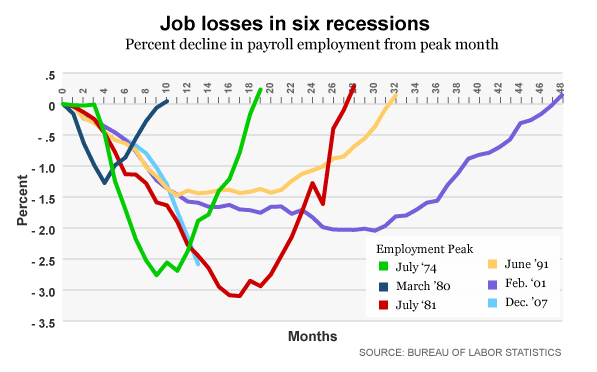
They ask, and Justin delivers, with the able assistance of TIME.com graphics wizard Feilding Cage. Here are comparisons to the nasty recessions of 1981-1982 and 1974-1975.:
six_recessions3

Justin’s conclusion:

What do we learn? So far the fall in employment is comparable to that in 1974-1975 and 1981-1982. If the comparison holds, the declines should end within the next four or five months. But we of course have no idea whether the comparison will hold. Past performance is no guarantee of future results.

Another lesson brought home by the chart is how weak the recovery from the 2001 recession was. It was a mild recession, but it took four years for employment to return to its February 2001 peak. Setting aside the worst-case scenario of a continued downward employment spiral that puts 1974-1975 and 1981-1982 to shame, a recession that combines a severity akin to that of 1974-1975 and 1981-1982 with a recovery as anemic as 2001-2002-2003-2004-2005 would be not a whole lotta fun.

Related Topics: Uncategorized
  • Latest on Swampland

    Pete Souza / White House

    Obama’s Persuasive Powers on Gay Marriage Manifest in Maryland

    When President Obama endorsed gay marriage earlier this month, the media grappled with two basic political questions: Was his personal “evolution” a case of a politician transparently following a national trend toward accepting same-sex unions (accelerated, perhaps, by his chatty No. 2), and would it hurt his re-election chances by alienating socially conservative voters like black churchgoers? Sure, there was a recognition that it marked a gratifying moment for gay-marriage advocates — as well as some grumbling about the President’s view that it remains a state issue, not a federal one. But by and large, there were few suggestions that one man, even the President, would shift public opinion on the issue or affect public policy. Based on a new Public Policy Polling survey out of Maryland, it seems this possibility was underestimated.

    Lewis Eisenberg, Major Romney Donor, Accuses Obama Of Demonizing Wall StreetHuffPost Politics

    Cherokee Zero

    Apparently, Massachusetts voters don’t mind that Elizabeth Warren foolishly identified herself as a Native American early in her academic career–it was, apparently, a case of family pride and wishful thinking about a Cherokee ancestor. That’s good. Warren may be the best public figure when it comes to explaining the depredations of the financial industry and [...]

  • FlownOver

    Another conclusion: reliance on tax cuts as the sole – or even primary – recovery tool is either stupid or nuts, or a rare combination of both. Somebody please tell Boehner, Cantor, McConnell and both the Arizona Boneheads.

  • stuartzechman

    Thank you so much for this clarifying post, KT.

  • ivb3016

    Is the turquoise line supposed to be Dec 07 as labeled or Dec 08?

  • newfloridian

    The Republicans Boehner, Cantor, McConnell etc. all represent great states… specifically the state of Denial! They’ve joined the Rush Limbaugh wing of the party that hopes that Obama fails and so does America. All the people are Republicans first and foremost. America is only important if it fits their agendas.

    The stimulus package probably has a 3 to 4 month start-up window at best, which means no real results for 5 months and a reduction in unemployment maybe in August or September which is short circuited by the normal November-December layoffs, which means probably January 2010 at best. Everyone needs to realize that because of the gaming of the unemployment numbers the real rate is over 11%. We could see 11% in faked numbers before this is all over with a real rate exceeding 15%. Can’t tell you how much pain and suffering we are going to be in for.

    On another subject the food-power crisis in rural Alaska is finally getting some major press. This may well be Gov. Palin’s own Katrina. Once again a Republican leader ignores a serious human survival crisis. Wouldn’t it be interesting if the Federal Government declared the Alaska situation a national emergency and began airlifting food and supplies to rural Alaska because the State of Alaska can not handle the situation. Talk about a stake through the heart move. But then again why disable an already disabled Republican who would be a disaster as her party’s nominee.

  • http://smoothlikeremy.blogspot.com/ sgwhiteinfla

    Here is what I see from the graph and feel free to correct me if I am wrong. In 74 the initial down turn to the low point took around 8 months. Now according to the graph us getting to almost the same low point took 13 months. But when I look at literally where we fell off the cliff in 74 vs where we fell of the cliff last year it appears that we are falling faster. From the graph it looks like in 74 it took about 5 months from month 3 to month 8. But on the graph line for the current crisis we fell off the cliff around month 9 to month 13 which would be 4 months. And really even if the bill is passed I don’t think it will change the trend line down for this month which would mean that we will be looking t 81 numbers but we would have achieved them in a matter of 14 months as opposed to 17 months.
    .
    And these stupid muthaphuckas keep asking why we need to move fast? Jeebus.

  • http://smoothlikeremy.blogspot.com/ sgwhiteinfla

    Here is what I see from the graph and feel free to correct me if I am wrong. In 74 the initial down turn to the low point took around 8 months. Now according to the graph us getting to almost the same low point took 13 months. But when I look at literally where we fell off the cliff in 74 vs where we fell of the cliff last year it appears that we are falling faster. From the graph it looks like in 74 it took about 5 months from month 3 to month 8. But on the graph line for the current crisis we fell off the cliff around month 9 to month 13 which would be 4 months. And really even if the bill is passed I don’t think it will change the trend line down for this month which would mean that we will be looking t 81 numbers but we would have achieved them in a matter of 14 months as opposed to 17 months.
    .
    And these stupid muthaphuckas keep asking why we need so move fast? Jeebus.

  • http://phd9.blogspot.com Paul Dirks

    One of my memories of the 81-82 recession is that Reagan did an excellent job of breaking the backs of Unions so that the jobs that did return were significantly less lucrative (and significantly less based on manufacturing) than the ones that were lost. I also have the impression (not guaranteed accurate) that there was a sharp increase in the reliance on lines of credit and home-equity loans to make up for the loss of direct income. (If I’m wrong about any of this, then by all means, someone who knows better should chime on in!)
    .
    That tells me to, that direct comparisons will always fall short. From where I sit, it appears that the manufacturing backbone that we lost in the eighties never recovered adequately and that we’re now expreiencing the backlash of relying on an economy that doesn’t actually produce value, but merely shuffles it around.

  • jaw83

    Here is the federal funds rate historically http://www.newyorkfed.org/markets/statistics/dlyrates/fedrate.html

    The striking difference, and what makes this downturn so scary, is that we don’t have monetary policy to help get us out of this mess.

  • http://nicewhitelady.blogspot.com/ joyomama

    Very informative, but I found the less-saturated colors hard to see. Any chance of making the older dates lighter/less saturated and the newer dates progressively darker/more saturated? (Imagine it in gray-scale).
    .
    Excuse the design nerdiness.

  • nsb123

    An observation if it is valid and not just random occurrence, it is really really scary.

    Length of time it took to regain all jobs lost. That is for the line to come back to zero.

    1974 – 19 months
    1981 – 28 months
    1991 – 32 months
    2001 – 48 months

    As you can see, each subsequent recession has taken longer time to regain all lost jobs. One reason that I can think of, in each recession, US became more open to out-sourcing and it took longer to gain job in US. If this is valid and trend continue, this will not only be deeper job recession but would take much longer than all earlier recession.

  • http://phd9.blogspot.com Paul Dirks

    US became more open to out-sourcing and it took longer to gain job in US.
    .
    The trouble with that logic is that there is a point when foreign labor markets will be saturated as well, and the advantages of offshore labor will diminish. This is actually as it should be. The disparity in standards of living between the US and other countries is NOT something to be proud of.

  • http://leisureguy.wordpress.com/2009/02/09/another-graph-of-recent-recessions/ Another graph of recent recessions « Later On

    [...] This one is from Swampland. Their comment: What do we learn? So far the fall in employment is comparable to that in 1974-1975 and 1981-1982. If the comparison holds, the declines should end within the next four or five months. But we of course have no idea whether the comparison will hold. Past performance is no guarantee of future results. [...]

  • http://tottinge.blogsome.com/2009/02/09/ressionary-job-loss-graphs/ Blogging Ottinger (tim) :: Ressionary job loss graphs :: February :: 2009

    [...] How bad is it? This is how we stack up against a few other recessions: [...]

  • http://swampland.blogs.time.com/2009/02/06/how-bad-is-it/ How Bad Is It? :: Swampland – TIME.com

    [...] How Bad Is It? (Monday Edition) [...]

  • nsb123

    Paul, we are long way from saturating foreign labor market. India and China are both 1 billion plus population. I am from India and trust me, we are not even scratching the surface of cheap labor pool.

  • iwasindependent

    Paul: ” The disparity in standards of living between the US and other countries is NOT something to be proud of.”
    .
    While I agree with you, this is something that’s supposed to stay inside our heads, and not said out loud. Could you ever imagine a politicians saying this? He/she couldn’t get even elected Assistant to the Regional Dogcatcher.
    .

  • http://engstudent.wordpress.com/ Eric the student

    damn – that really was scary. Nancy appearently has some good staticians (:

  • donovong

    Any chance of getting the Mother of all Depressions – 1929-1940 – on there, for purposes of comparison?

  • xtopherarmour

    Apparently, Feilding Cage doesn’t know the difference in an apostrophe and a single open quote.

  • oizydoizy

    It looks like the inflection point (change of slope toward bottoming out) generally occurs at about half the maximum job loss percentage.
     
    Unfortunately, in this recession, we haven’t reached the inflection point yet. Even in the rosiest of scenarios, where today is the inflection point, the job loss percentage would reach 5%.
     
    However, given that nothing has actually stimulated the economy yet, I’d say that we haven’t yet reached the inflection point, and the maximum job loss percentage will be significantly higher than 5%.

  • sneezeguard

    People talk about the recession like it’s a deviation from what was once a rosey picture, but the fact of the matter is that things have been bad for awhile, and we’ve just kept our heads in the sand about it.

    We have current problems. We don’t invest enough in infrastructure and the private sector produces too many jobs that reshuffle things rather than make them.

    But we also have a too rosey view of the world how it is, we have to realize that yes, America is part of the world at large, and no, we can’t just ignore it.

  • http://engstudent.wordpress.com/ Eric the student

    Oizydozy thats what I was looking for when I looked at the graph and since I didnt see it, I assumed it may begin a few months after so called shovel ready projects are brought online.

    Be interested to see how effective the stimulus is that is how long the economy will be in the reccession, given previous situations.

  • http://engstudent.wordpress.com/ Eric the student

    QUOTE::nsb123 Says:
    Monday, February 9, 2009 at 12:07 pm
    An observation if it is valid and not just random occurrence, it is really really scary.
    Length of time it took to regain all jobs lost. That is for the line to come back to zero.
    1974 – 19 months
    1981 – 28 months
    1991 – 32 months
    2001 – 48 months
    As you can see, each subsequent recession has taken longer time to regain all lost jobs. One reason that I can think of, in each recession, US became more open to out-sourcing and it took longer to gain job in US. If this is valid and trend continue, this will not only be deeper job recession but would take much longer than all earlier recession.
    .
    .
    Very good point I didnt notice that, it better not be an unbounded, I dont know what to call it. I wonder if somebody can do a regression analyisis on how bad reccessions are getting in monetary loss adjusted for inflation and how bad theyre getting in terms of how long it takes to recover form them.
    .
    Also – what is the tipping point where we start calling this one a depression – and whats the possibility of other emerging economies in the world recovering before the U.S. does?

  • http://engstudent.wordpress.com/ Eric the student

    1981′s reccession was 9 months longer than 1974s 6 year break
    1991′s reccession was 4 months longer than 1981′s 10 year break
    2001′s reccession was 16 months longer than 1991′s also 10 year break
    2007′s reccession came early after a 6 year break and lets hope it doesnt last the avg of 9.66 months longer than the last one which lasted 48months.

  • wcmh

    Thanks for making this improvement–it is now obvious that this is not much different than either the 1973/74 or the 1981/82 recessions. Someone wondered why it dropped so fast in the last 4 months–well, September was when Paulson started running around like a chicken with its head cut off. And that is when unemployment took a STEEP increase–the statements of “leaders” has a direct impact on the real economy. If Obama keeps up his doom and gloom talk, then, yes things could get even worse. He is either ignorant of the impact his words have (saying things like “catastrophe” and “we might never recover”) or he is INTENTIONALLY trying to bring about a depression to further his socialist ambitions, ala FDR in the 1930′s. This is either ignorant or treasonist–take your pick.

  • wcmh

    Eric, I think a big reason for what you are seeing as far as the timeframe for the “recovery of jobs” is the impact of illegal aliens on the economy. These jobs have grown tremendously in the last 20 years and are not counted in these job numbers.

  • wcmh

    One last thing–there is already a LOT of “stimulus” in the economy–the Fed has been “stimulating” for months, with interest rates near 0. To say that we need this huge “socialist’s dream” of a spending package to recover from this recession ignores the impact of the Fed. We’d be better off if Congress went on vacation and Obama played with his kids in the White House and quit talking the economy lower!

  • http://nicewhitelady.blogspot.com/ joyomama

    wcmh-
    .
    got fact-based links to back up those opinions? Let’s see’em.

  • http://kegill.wordpress.com/ kegill

    Let me join the ditto of thanks.

    A few other points:
    (1) The 70s recession resulted from an oil price shock, which also helped drive up food prices.

    (2) Some people say the 80s recession was self-inflicted (Fed trying to control inflation) but if so, those measure were at least in part a response to the oil price shock. I remember those interest rates, it’s when I bought my first house. Of course, deregulation of S&Ls led to more bloodletting from the Treasury.

    I agree with the statement that manufacturing never recovered from the 1980s recession. I also think this is a continuation, to some extent, of the bust from earlier this decade. (Like this is hard to argue — both were bubbles.)

    As far as disparity in living conditions in the US and the rest of the world … our happy metaphor (rising tide lifts all boats) is incomplete, as tides do not rise indefinitely. The fact is that this income gap (US v world) is more unsustainable over the long haul than the wage gap inside the U.S., IMO. I have no data to back up this opinion, just extrapolating from the way trade works. So yes, US Y will fall as India’s Y rises.

  • http://kegill.wordpress.com/ kegill

    OH! I forgot – I also agree with wcmh re how public statements can sway public opinion and thus the direction of the economy.

  • wcmh

    joyomama, not sure which you are referring to, but here is an article that shows the huge jump in unemployment starting in the month of September:
    Jobless rate surges to 7.6%

    The chart is about 3/4 of the way down in the article. Through August, losses were averaging less than 100,000/month, then they jumped to about 400,000 in September and October, and then to 550,000-600,000 from November to January.

  • wcmh

    joyomama, as far as “stimulus” already in the economy, this link shows what the Fed has done in the last few months:
    Federal Funds and Discount Rates
    You’ll note that since October 8, the discount rate has been reduced from 2.25% to 0.5% and the fed funds rate has been reduced from 2.00% to “0.00 – 0.25%”.

    I will also note that an additional “stimulus” already build into the economy is about a $2/gallon DROP in gas prices. This will help also.

    Having some problems with putting links in here, so if it doesn’t go, here is the name of the page: “http://www.newyorkfed.org/markets/statistics/dlyrates/fedrate.html”

  • http://henchook.blogli.co.il/archives/663 מה את/ה אומר/ת? » כמה באמת רע המצב?

    [...] להאמין למאמר ב-TIME,המצב הנכחי דומה למה שהיה ב-74-75 וב-81-82, זאת אומרת שאם המצב [...]

  • wcmh

    Kegill, good thoughts on the 70′s and 80′s. The other thing that happened in the 70′s was Nixon’s wage and price controls–this, along with the oil shocks in 1974 (OPEC) and 1979 (overthrow of the Shaw and the Islamic Revolution) and the Hostages crisis also impacted the economy. Paul Volker (the Fed Chair) raised the fed funds rate up to 15.5% in October 1979 to squeeze out inflation. It certainly worked, since inflation, which maxed out at almost 15% in early 1980, dropped below 5% by 1982 during the 1981/82 recession. The high interest rates certainly exacerbated the recession, but they were needed to break the back of inflation. It has only intermittently been above 5% since then (such as during the Gulf War in 1990.

  • wcmh

    I meant to also say in the last post, that the fed funds rate was further pushed up to between 19% and 20% in late 1980 and into 1981. The push in 1979 was eased because of the (shallow) 1980 recession, which ended in the summer of 1980. The 1981 recession began in July 1981.

  • 53_3

    wcmh:
    .
    I think you don’t really know much about FDR and are really just spouting a lot of bullshirt.
    .
    Your characterization of Obama’s statements is really disengenuous, as I might point out sharply that only a weakly supported system is affected by talk alone.
    .
    To wit:
    What would you say to Nissan, who made a statement today with far more specifics than Obama, other than his very sage warning that more difficulties are in our future?
    http://www.nytimes.com/2009/02/10/business/worldbusiness/10nissan.html?partner=rss&emc=rss
    .
    I would venture to say that what you are saying is that you want to hear lies:
    “The fundamentals of the economy are sound.”
    .
    By 1934, FDR’s policies had pulled the US out of the Depression, with the federally funded construction of a very large array of infrastructure projects, as well as other makework programs.
    .
    Granted that in this day and time, FDR’s pioneering is antiquated, but it can still be an effective method for kickstarting the migration of Americans back into jobs.
    .
    At the very best, your commentary just borders on rhetoric (the “socialism” angle) with very, very little factual basis.
    .
    None of us fear “socialism” as much as you do, but then again, it seems to be important to you. My suggestion:
    .
    Run like hell!
    .
    As a final point, I can safely say that we now have proof in hand that “trickle down” economics does not work:
    .
    The Bernanke/Paulson injection into the financial black box, which is far more effective than any tax cut:
    http://blogs.moneycentral.msn.com/topstocks/archive/2008/11/24/the-real-bailout-cost-7-4-trillion.aspx
    .
    Now, I point out sharply, if “trickle down” had any chance of working, some boats would have floated by now. Remember the old line of giving tax breaks to the highest income individuals and corporations and the rising tide will float all boats?
    .
    Nah. Not on your life. The banks havn’t even loosened credit yet. And certainly, loosing 598,000 jobs is not exactly a sign that anyones boats are floating, let alone staying above water.
    .
    I’d go home, and rethink your entire outlook on life…

  • wcmh

    “I think you don’t really know much about FDR and are really just spouting a lot of bullshirt.”
    .
    You say you “think”, but you proved by later statements that you do not know much about anything.
    .

    “By 1934, FDR’s policies had pulled the US out of the Depression, with the federally funded construction of a very large array of infrastructure projects, as well as other makework programs.”
    .
    LOL! Even Keynes himself would not agree with you! And Roosevelt’s own friend and Treasury Secretary did not agree with you! First of all, the Depression did not end in 1934. The unemployment rate in 1934 was still above 20%, about 3 times what it was in January. It was above 15% throughout the 1930′s, then dropped to around 10% by 1941, and didn’t drop below that until the war effort kicked up in 1942. Please, it’s better to be quiet and be thought a fool, than to type on your keyboard and remove all doubt!
    .
    There were two recessions within the Great Depression. The first from 8/29-3/33 and then from 5/37-6/38. But the Great Depression went on thoughout the 1930′s.
    .
    Henry Morganthau, Roosevelt’s friend and Treasury Secretary famously said in May of 1939 “We have tried spending money. We are spending more than we have ever spent before and it does not work. And I have just one interest, and if I am wrong … somebody else can have my job. I want to see this country prosperous. I want to see people get a job. I want to see people get enough to eat. We have never made good on our promises … I say after eight years of this Administration we have just as much unemployment as when we started … And an enormous debt to boot!”
    .
    That statment may sound hauntingly familiar in a few years…
    .
    “Your characterization of Obama’s statements is really disengenuous, as I might point out sharply that only a weakly supported system is affected by talk alone.”
    .
    Of course the economy is “weak”–duh, we’re in a recession! Even your hero FDR (who, according to you got us out of the Great Depression in 1934, LOL) knew better than to talk down the economy–you’ve perhaps heard of the famous line from his inauguration speech in 1933? He said “We have nothing to fear, but fear itself”. That should have been a clue to Obama that fostering fear is how you EXTEND economic woes–not how you end them. Try taking an economics course, or even a psychology course, if you don’t know this!
    .
    “At the very best, your commentary just borders on rhetoric (the “socialism” angle) with very, very little factual basis.”
    .
    And when has spending lots of money on liberal pet projects EVER helped an economy? FDR did it and he presided over the Great Depression. Japan tried it in the 1990′s and they now call that “the lost decade”. Isn’t the definition of insanity doing the same thing over and over and expecting a different result?
    .
    “Now, I point out sharply, if “trickle down” had any chance of working, some boats would have floated by now. Remember the old line of giving tax breaks to the highest income individuals and corporations and the rising tide will float all boats?”
    .
    Bush and Congressional Republicans spent way too much money, so you want to solve that by what?–spending more money? What a solution! I won’t even get into the proximate cause of this recession–the housing bubble. Both parties bear some responsibility for it and Greenspan bears a huge reponsibility for it by not raising interest rates MUCH sooner.
    .
    “I’d go home, and rethink your entire outlook on life…”
    .
    You first.

  • wcmh

    An excellent commentary from Barron’s:
    .
    The government’s meddling got us into this mess

  • wcmh

    For some reason the link did not work. It should be:
    .
    http://online.barrons.com/article_email/SB123396551669058895-lMyQjAxMDI5MzAzNzkwNjc1Wj.html
    .
    You can just copy and paste the link…

  • http://engineeringpolitics.wordpress.com/2009/02/11/more-recession-graphs/ More Recession Graphs « Engineering Politics

    [...] Recession graph [...]

  • http://www.whyweworry.com/blog/2009/02/11/mental-health-break-non-economy-edition/ Why We Worry » Blog Archive » Mental health break: Non-economy edition | 100% against economic recovery

    [...] numbers look a little less scary when jobs losses are shown as a percentage of the population. Right now it’s about as bad as the recession in mid [...]

  • http://www.eclaireur.net/internet/le-moral-en-berne-ce-grahique-ne-va-pas-aider-a-rassurer/ Le moral en berne? Ce grahique ne va pas aider à rassurer !

    [...] pour l’avoir en meilleure qualité). De plus j’ai également vu sur un autre blog américain les 6 dernières récessions en graphique. J’aimerai bien connaître un peu les statistiques françaises… car je n’ai [...]

  • http://tutousan.wordpress.com/2009/02/13/the-one-with-where-it-looks-bleak/ The One With Where It Looks Bleak « So no one told you life was gonna be this way.

    [...] From time.com [...]

  • http://blog.photobiker.com/index.php/2009/02/22/we-are-not-in-the-merde/ Charm and Strange » We are not in the merde

    [...] friend Daniel pointed to that chart from Time Magazine showing the unemployment figures from the past 6 recessions in the US. The [...]

  • http://waitingcasually.com/2009/02/its-real-bad/ It’s Real Bad – Waiting Casually

    [...] even though they want to. Everywhere you turn, more and more data becomes available that illustrates just how dire our situation is. If there’s any confusion, allow me to clear it up: it’s really bad. We are not [...]

  • http://swampland.blogs.time.com/2009/03/16/this-is-not-the-great-depression/ This Is Not The Great Depression :: Swampland – TIME.com

    [...] | Comments (0) | Permalink | Trackbacks (0) | Email This We’ve been offering you some scary jobs charts lately, so here’s a more reassuring one (relatively speaking) from Justin [...]

  • http://blog.reflexionsdata.com/2009/04/07/six-ways-to-strengthen-your-business-in-this-recession/ Six Ways to Strengthen Your Business in This Recession | the reflexions insider

    [...] recession since the 1980’s and it will probably be the deepest since the 1930’s. Charts like these are enough to make anyone feel like we’re collectively driving off an economic [...]

blog comments powered by Disqus